03/ 06
Ellum Harness
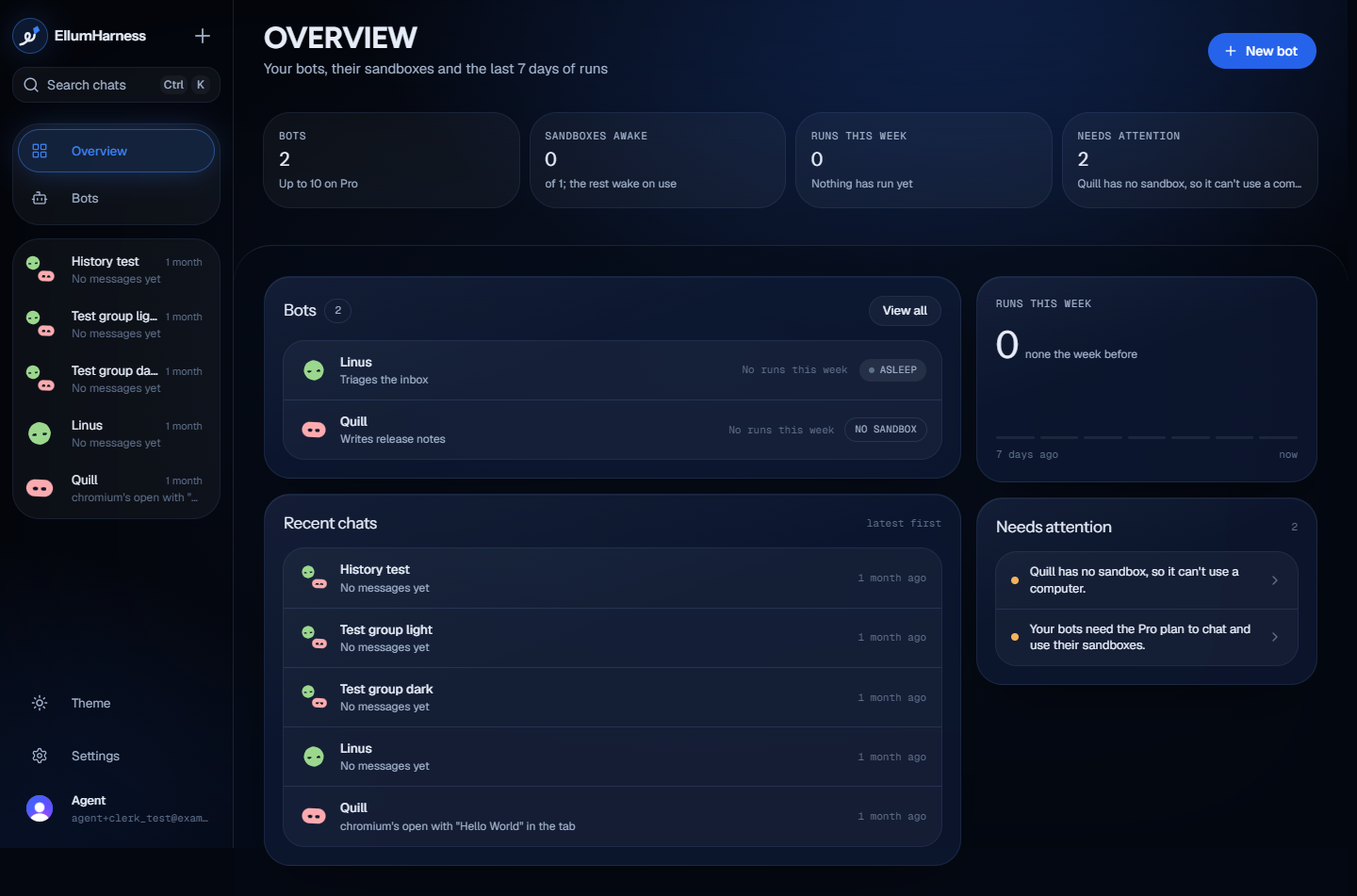
I designed and built Ellum Harness, a web app where you make your own AI bots and each one gets its own computer in the cloud. You give a bot a face, a name, a job and instructions, then chat with it while it runs commands, opens apps and works the screen. It's live behind sign-in.
What it does
- Every bot has its own cloud sandbox with a desktop. A panel beside the chat streams that desktop live, and you can open it full screen and take the mouse and keyboard yourself.
- The bot works with real tools: a shell, files, the mouse, the keyboard and screenshots of its own screen.
- Group chats put several bots in one conversation. You pick who answers or @-mention a bot by name, and a bot can hand a message to the bot whose job it is.
- Bots remember. Each one keeps a memory file in its sandbox, so something you told it in a private chat is still known in a group chat.
- Creating bots, chatting and opening desktops need the Pro plan. It comes with a monthly allowance of 10 million AI tokens, 30 hours of sandbox time and 20 new bots, and a Usage page counts down to the reset.
How I built it
It's Next.js 16 and TypeScript, with Clerk for sign-in and billing, Postgres on Neon through Drizzle, and Daytona for the sandboxes. The chat runs as a durable agent on Trigger.dev, not in a route handler, so an answer that's still streaming survives a page reload.
The desktop panel is one iframe. It's created the first time you open the panel, then moved between the panel and the full-screen dialog, so the remote desktop connects once and survives every open and close. The bot gives mouse positions on a 0 to 1000 grid instead of pixels, because that's the grid vision models find points on.
Handoffs go one hop only. A bot that was handed a message has to answer it, so two bots can't pass it back and forth forever. I wrote an eval of 26 cases that runs against the real prompt and tools. The second version of the prompt scored 86.5% accuracy with no false handoffs, but its recall was 75%, so it still misses one in four handoffs it should make.
What broke
- Every chat with a single bot failed before the bot replied. After an SDK update the agent checked each turn's metadata, and only group chats send any. I made the metadata optional.
- On longer tasks a bot got stuck making the same tool call again and again. My code that moved screenshots between steps hit an SDK path that dropped every step after the second. I moved that code into a model middleware.
- Computer use needs the bot to see its screen, but the model provider rejects images in tool results. So each screenshot goes into a user message instead, and only the newest one is kept.
- When the main model errors or hasn't started answering within 20 seconds, the chat falls back to a second model. It then skips the main one for 2 minutes, so every step doesn't pay the same timeout again.
- The first deploy quietly installed different dependencies, because the host's default bun couldn't read my lockfile. I pinned bun to the version I use locally.
I built it over 37 commits from October to November 2026, 8 of them with Claude.
Open to full-time roles