04/ 06
Raven Mail
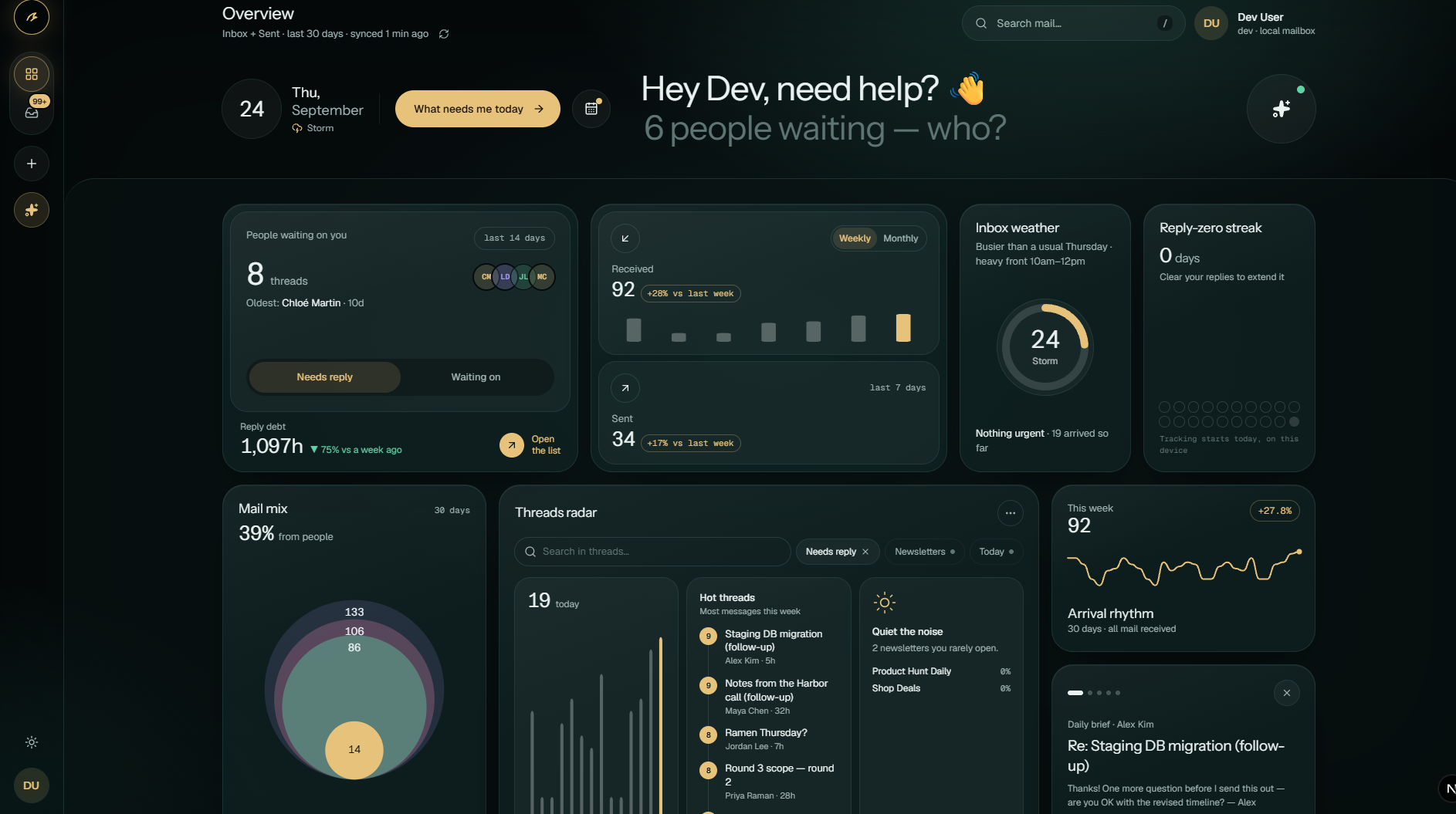
I designed and built Raven, an open-source email client that reads your inbox before you do. Sign in with Gmail, Outlook, Yahoo, iCloud, Fastmail, Proton (through Bridge) or any IMAP mailbox, and the Overview shows who's waiting on you, who owes you a reply and what can wait. It runs on the web, self-hosted with Docker, or as a desktop app for Windows, macOS and Linux.
What it does
- The Overview reads the last 7 or 30 days of mail live over IMAP: replies you owe, reply debt, inbox weather, newsletter open rates and a daily brief.
- Press Ctrl+K and ask in plain words, like "who's waiting on my reply?" Every answer shows the emails it came from.
- It's also a full mail client: a three-pane reader, rules written in plain English, Undo Send, follow-up reminders and keyboard shortcuts.
- There's no password database. Your mail login lives only in an encrypted cookie, emails render in a sandboxed frame with no scripts, and remote images stay blocked until you click.
How Ask works
Ask runs on Jev, a decision model from TypeSafe. It doesn't write text, it picks from fixed options. So Raven uses it to read the question and rank candidate emails, and computes dates and counts in code. A hostile email can at worst rank itself higher.
Without a key, Ask used to fall back to plain keyword rules. So I built Kage, a small engine inside Raven that answers the same questions with no key and no network. On a blind test set it got the intent right 88% of the time against 73% for keywords, but it was a bit worse at categories, 68% against 70%. If Jev doesn't answer within 3 seconds, Kage does. One version let Kage answer while the app still said Jev, so now every answer names the engine that gave it.
The hard parts
- Jev is cheap, but it isn't free, and every question costs a call. So I made Kage good enough to carry Ask on its own. In my last pass, wrong rule matches on my test emails went from 5 to 0, and Kage got five times faster, from 1.1 ms to 0.2 ms per answer. I had already read the old test cases, so they no longer count. A fresh blind set, written by an agent that never saw Kage's code, now sets the score, and a regression test fails if accuracy drops.
- Rules only act when they're sure: 70% confidence to move or archive, 85% to trash. Mail from people you write to is never moved, archived or trashed by a rule. I'd rather a rule miss a receipt than hide an email from your boss.
- One failed refresh hid the whole inbox behind an error screen, because TanStack Query reports an error even when older data is still on screen. Now loaded mail stays put, with a small "Couldn't refresh" line.
I built it over 179 commits from September to November 2026, 85 of them with Claude, and shipped 17 releases. It's Next.js 16 and TypeScript, and the desktop app runs the same server in Electron with PGlite as its database.
Open to full-time roles